Exterior foundation waterproofing in Tulsa seals a below-grade wall but requires excavating it; interior drainage with a sealed sump handles most cellars and partial basements within $1,500–$6,000. With 42 inches of rain arriving in bursts, most below-grade spaces here get interior drainage plus corrected grading.
What each approach does, what Tulsa’s housing actually has below grade, and the order to spend in.
What’s below grade in Tulsa — and why it matters
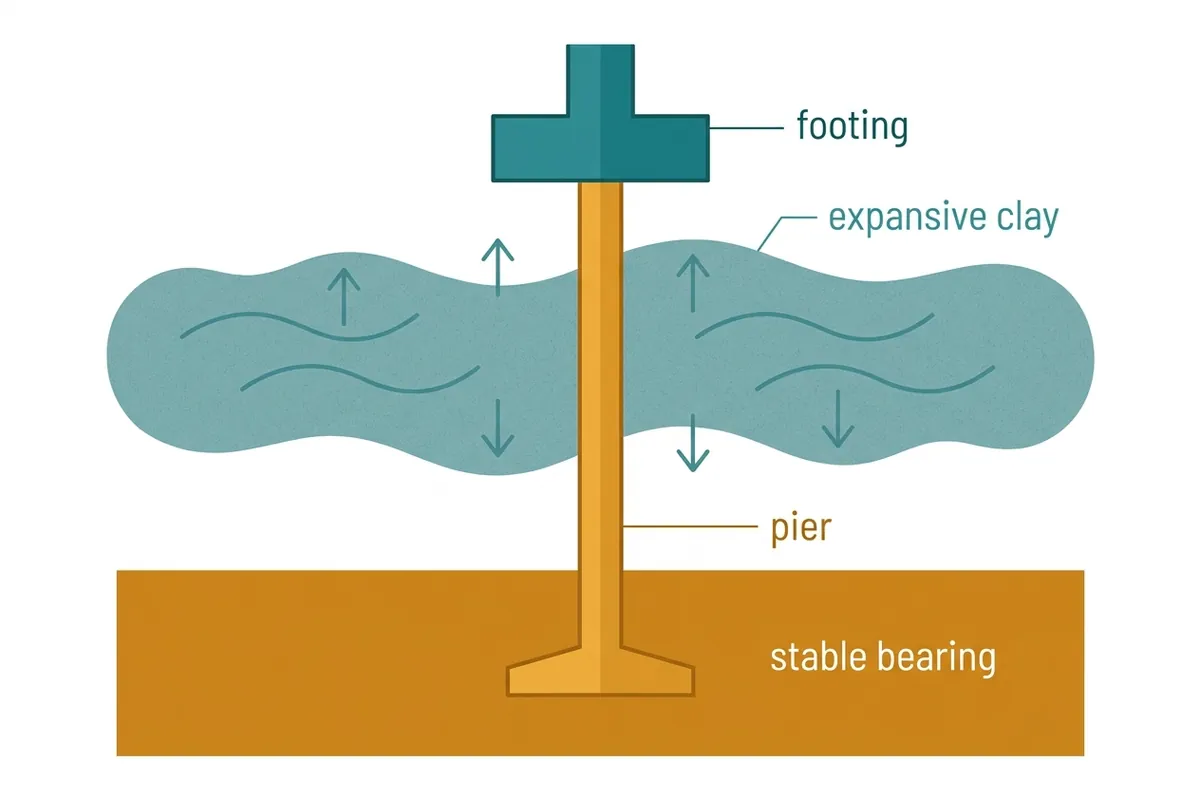
This is not basement country: the suburbs run slab, midtown runs pier-and-beam, and the below-grade spaces that do exist are partial basements, cellars, and storm shelters under the older stock. They’re small, but they sit in the same expansive clay that drives everything else here — swelling saturated against the walls in a deluge, shrinking away in a drought. Water management for these rooms is a scaled-down version of the full-basement problem, with one advantage: the smaller the perimeter, the cheaper every honest fix gets.
The two approaches, honestly compared
| Exterior membrane | Interior drainage | |
|---|---|---|
| What it promises | Water stopped at the wall face | Water collected at the footing, floor stays dry |
| Typical Tulsa cost | Per wall — excavation dominates | Most cellar/partial jobs inside $1,500–$6,000 |
| Disruption | Excavation along an occupied older house | Interior channel and sump, days |
| Swell pressure | Wall sealed; clay pressure remains | Water relieved at the footing |
| Best moment | Wall already open for other work | Occupied house, active seepage |
Where waterproofing meets foundation repair
The junction shows up two ways in Tulsa. A below-grade wall taking enough swell pressure to crack or lean needs structural attention — crack repair or bracing — and if that work opens the exterior, membrane and a footing drain go in for the cost of materials while the trench exists. And when the same moisture cycle has moved the house itself, the settlement conversation comes first, because releveling after waterproofing beats waterproofing twice. Sequencing is a scope decision, priced line by line in the cost guide.
Spend in this order
- First, the free-to-cheap outside fixes — downspout extensions, grading, discharge routing. A large share of wet cellars end here.
- Second, drainage correction proper — $1,500–$6,000 for the lot-level work that flattens the moisture swing at its source.
- Third, the interior system — perimeter channel and sealed sump for the space that still takes water after the outside is right.
- Last, exterior membrane — when a wall is open anyway, or a specific wall’s condition demands it.
What the system needs from you afterward
Drainage work fails from neglect long before it fails from age. Once a year, clear the discharge outlet and confirm it still carries water well away from the house, then walk the perimeter after the first real downpour — in a metro where 42 inches arrives in bursts, one storm will show you any channel the water has re-cut back toward the foundation. Clean the gutters; on a grade-level fix they are part of the system. If a sump is involved, pour a five-gallon bucket in and watch the float lift and the pump run rather than trusting a light. And keep the summer half of the job going: consistent perimeter moisture through drought season is what stops the clay from re-opening what you just closed.
Waterproofing questions, straight answers
Do Tulsa houses even need basement waterproofing?
Fewer than in basement country, but the ones that do, really do. Full basements are rare here; partial basements, cellars, and storm shelters under older midtown homes are common — below grade, surrounded by expansive clay, and wet in every deluge if drainage is wrong. The stakes are smaller than an eight-foot wall; the physics are identical.
Which approach fits a partial basement or cellar?
Usually interior drainage with a sealed sump. These spaces are small — a perimeter channel and sump often price toward the low end of $1,500 to $6,000 — and excavating outside an occupied older house to seal a half-depth wall rarely pays. The honest first move is cheaper still: most 'wet cellar' calls in Tulsa trace to downspouts and grading.
When does exterior sealing make sense here?
When the wall is already exposed. If a cellar wall is being rebuilt, an addition is going in, or a bowing section needs excavation anyway, membrane and a footing drain while the trench is open cost little and work well. Digging purely to waterproof a sound wall is usually Tulsa's wrong trade — the money does more in drainage correction.
What does the drought half of the cycle do to these spaces?
It moves them. The same shrink-swell that settles footings works the walls of below-grade rooms — cracks that open in August and weep in October are the classic sequence. That's why the evaluation reads structure and water together: a crack that moves seasonally needs monitoring or repair, not just sealant over it.
What should I fix before any system goes in?
The outside water, always. Downspout extensions, grading that falls away from the house, and a working discharge route — the drainage-correction playbook, $1,500 to $6,000 and often far less — solve many wet below-grade spaces outright and shrink the system every remaining one needs. We start every wet-cellar call at the gutters, not in the cellar.
What part of this can I do myself?
The cheapest part, usually, and often the highest-return. Extending downspouts, clearing gutters, and correcting the first ten feet of grade are homeowner work, and on plenty of houses they solve the problem outright — we would rather tell you that than sell you a system. What is not DIY is anything needing excavation, a footing-level drain, or a sump tied into plumbing and electrical.
Get a free Tulsa foundation evaluation
Tell us what the house is doing — stair-step cracks, doors that stick every August, sloping floors, separating trim — and we’ll schedule an evaluation with photos and measurements. We reply the same business day.